


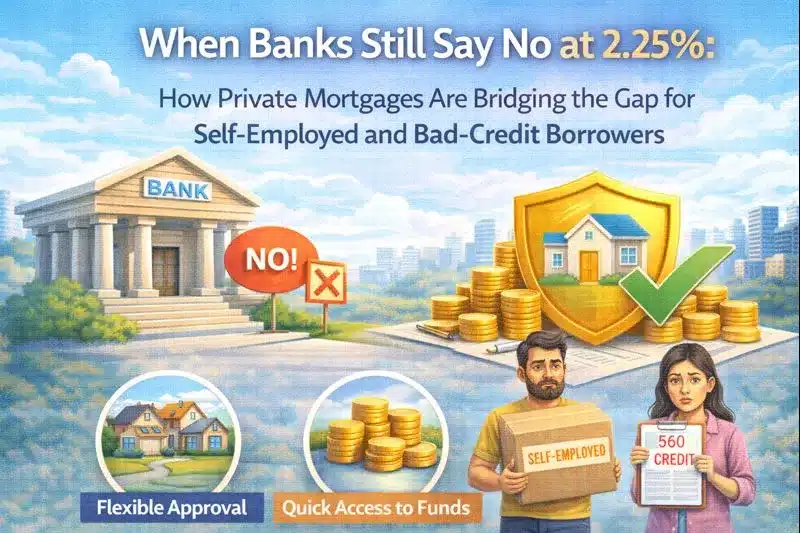
With the Bank of Canada stabilizing policy near 2.25%, many Canadians expected mortgage approvals to suddenly become easy again. Yet across Surrey, Abbotsford, the Fraser Valley, and Edmonton, thousands of borrowers are still hearing the same frustrating answer:
“Declined by the bank.”
This disconnect confuses many buyers and homeowners. If rates have stabilized, why are approvals still difficult?
The answer is simple:
Rates affect affordability—but banks still lend based on rigid income, credit, and documentation rules.
For borrowers who fall outside those narrow rules—self-employed professionals, business owners, newcomers, and credit-challenged households—private mortgages have become the most powerful bridge between rejection and homeownership, refinancing, or renewal recovery.
This guide explains exactly how private mortgages work in 2026, who they serve best, and how disciplined borrowers use them as strategic stepping stones—not permanent debt traps.
Why are banks still declining borrowers even at 2.25%?
Banks do not underwrite mortgages based on rate alone. They rely on:
- Strict tax-documented income
- Two-year historical averages
- Credit score thresholds
- Automated underwriting systems
- Conservative risk models
Even with lower rates, many qualified real-world borrowers fail these filters due to:
- Income volatility (business owners, contractors)
- Recent credit events
- High but temporary debt ratios
- New-to-Canada profiles
- Rental income not fully recognized
- Overtime or commission income not accepted
Banks are designed to avoid risk, not to adapt to unique financial realities.
Private lenders exist precisely because of this structural gap.
What exactly is a private mortgage in 2026?
A private mortgage is a non-bank loan secured by real estate, funded by:
- Individual investors
- Mortgage investment corporations (MICs)
- Private lending pools
Key characteristics include:
- Shorter terms (6–24 months typically)
- Higher interest rates than banks
- Greater flexibility in income and credit evaluation
- Faster approval timelines
- Strong focus on property equity and exit strategy, not tax returns
Private mortgages are not designed for indefinite borrowing. They are transitional tools used to stabilize financial positioning.
Who actually needs private mortgages today?
In 2026, private lending is most commonly used by:
- Self-employed professionals
- Business owners with strong cash flow but weak tax income
- Commission-based earners
- New immigrants with limited Canadian credit history
- Borrowers recovering from consumer proposals or collections
- Homeowners facing renewal declines
- Buyers with large down payment but weak documentation
- Investors executing refinance-heavy strategies
Private lending is no longer niche—it is a critical structural layer of the Canadian mortgage ecosystem.
Why self-employed borrowers struggle with bank approvals?
Self-employed borrowers often:
- Minimize taxable income for efficiency
- Write off legitimate business expenses
- Show fluctuating net income year-to-year
- Operate through corporations rather than T4 income
Banks underwrite based on declared net income, not real-world cash flow. As a result, many productive business owners appear “unqualified” on paper.
Private lenders instead evaluate:
- Gross business revenue
- Bank statements
- Business sustainability
- Industry risk
- Historical performance trends
- Property equity position
This allows many self-employed borrowers in Surrey, Abbotsford, and Edmonton to secure financing even when banks refuse.
Why bad-credit borrowers still get approved privately?
Bad credit does not automatically mean high risk—it often reflects temporary disruption, including:
- Job loss during inflation spike
- Illness or family emergencies
- Business cash-flow shock
- Divorce or separation
- Consumer proposal during peak rate stress
Private lenders focus on:
- Current income recovery
- Stability trajectory
- Property equity cushion
- Exit timing into prime lending
They are less concerned with past mistakes and more focused on future recoverability.
This is why many borrowers rebuild into full bank mortgages within 12–24 months after entering private lending correctly.
Why Surrey produces high private mortgage demand?
Surrey private mortgage demand remains strong due to:
- Large self-employed population
- Trades and construction workforce
- Real estate–driven entrepreneurial economy
- High property values relative to bank documentation income
- High renewal pressure from prior low-rate borrowers
Many Surrey homeowners use private second mortgages to:
- Bridge renewals
- Consolidate consumer debt
- Prevent power-of-sale situations
- Fund legal suite construction
- Stabilize finances before returning to prime lending
Why Abbotsford private lending is more strategic than reactive?
In Abbotsford, private mortgages are often used for:
- Acreage property refinancing
- Agricultural business cash flow
- Multi-generational household restructuring
- Investor repositioning projects
- Short-term renovation financing
These borrowers often hold strong equity positions, allowing private lending to function as controlled capital deployment rather than emergency funding.
How do private mortgage rates compare in 2026?
Private mortgage rates are higher than banks due to:
- Increased risk absorption
- Short-term structure
- Flexible underwriting
- Fast execution timelines
However, the true cost of private lending must be measured against what it prevents or enables, such as:
- Avoiding forced property sales
- Preserving long-term equity
- Enabling business continuity
- Preventing collection escalation
- Controlling debt before it compounds
Used properly, private mortgages often cost less than the long-term consequences of inaction.
What role does equity play in private approvals?
Equity is the foundation of private lending.
Most private lenders require:
- Minimum 20% equity for first mortgages
- 30%–40%+ combined loan-to-value for second mortgages
- Clean title and zoning
- Clear exit strategy
The stronger the equity position, the:
- Lower the rate
- Lower the lender risk
- More flexible the loan terms
Borrowers with equity but weak income profiles are often ideal private mortgage candidates.
How do private second mortgages differ from HELOCs?
HELOCs require:
- Strong credit
- Stable prime income
- Full bank qualification
Private second mortgages allow:
- Equity access without bank qualification
- Fast capital deployment
- Short-term restructuring
- Strategic renovation or consolidation
Many borrowers who cannot access HELOCs safely use private second mortgages as temporary substitutes, then refinance back into bank HELOCs after credit recovery.
What makes private mortgages safe when structured correctly?
Private mortgages remain safe when:
- The borrower has a clear exit strategy
- Income recovery is realistic within 12–24 months
- Equity remains protected with contingency buffer
- Debt consolidation produces net positive cash flow
- Property value is not speculative or unstable
Private lending becomes dangerous only when used:
- Without refinance planning
- For depreciating consumer spending
- To repeatedly delay insolvency without recovery strategy
How do borrowers exit private mortgages successfully?
The most common exit strategies include:
- Refinancing into prime lending after credit rebuild
- Income re-verification after business stabilization
- Selling a non-core asset
- Converting to conventional rental mortgage
- Rolling into HELOC-based consolidation
Private mortgages are not endpoints—they are bridges.
What mistakes trap borrowers in private lending?
The biggest errors include:
- Ignoring exit strategy at entry
- Using private funds for lifestyle expenses
- Failing to repair credit during the term
- Accumulating more debt instead of consolidating
- Allowing interest to capitalize uncontrolled
- Relying on indefinite equity appreciation
Private lending must be actively managed, not passively carried.
Why private mortgages remain critical in 2026 despite rate cuts?
Because the mortgage market is not just about rates—it is about who fits inside bank underwriting models.
Even at 2.25%, banks still decline:
- Self-employed borrowers with optimized tax filings
- Borrowers recovering from short-term credit disruptions
- New Canadians without long credit history
- Investors between refinance cycles
Private lending is not a last resort—it is a structural necessity for these groups.
Expanded FAQs — Private & Alternative Mortgages (2026)
Are private mortgages legal and regulated?
Yes. They operate under provincial lending and brokerage regulations.
Do private mortgages affect credit scores?
The mortgage itself does not harm credit; payment behavior matters.
Can private mortgages be used for purchases?
Yes, especially for buyers with large down payments but weak documentation.
How fast can private approvals happen?
In some cases, within days once valuation and title review are complete.
Are private mortgages only for bad credit?
No. Many high-net-worth and self-employed borrowers use them strategically.
Can private borrowers later qualify for bank mortgages?
Yes—this is the primary long-term goal in most cases.
Is interest tax deductible on private mortgages?
In certain investment cases, yes—tax advice is recommended.
Can a private mortgage stop foreclosure?
Yes, when structured before enforcement escalates.
Final Perspective: Private Mortgages Are Not Failure—They Are Financial Strategy
Even with rates stabilized, banks are not designed for financial complexity. They lend best to predictable, salaried profiles—but modern borrowers are far more dynamic.
Private mortgages fill that gap.
For self-employed professionals, recovering credit borrowers, investors between refinance cycles, and homeowners under renewal pressure, private lending provides:
- Time
- Stability
- Liquidity
- Strategic reset
Sandhu & Sran Mortgages structures private and alternative mortgage solutions across Surrey, Abbotsford, the Fraser Valley, and Alberta, helping borrowers move from decline to stability—then from stability back into prime lending.
Private mortgages are not about desperation.
They are about discipline, strategy, and controlled financial recovery.