


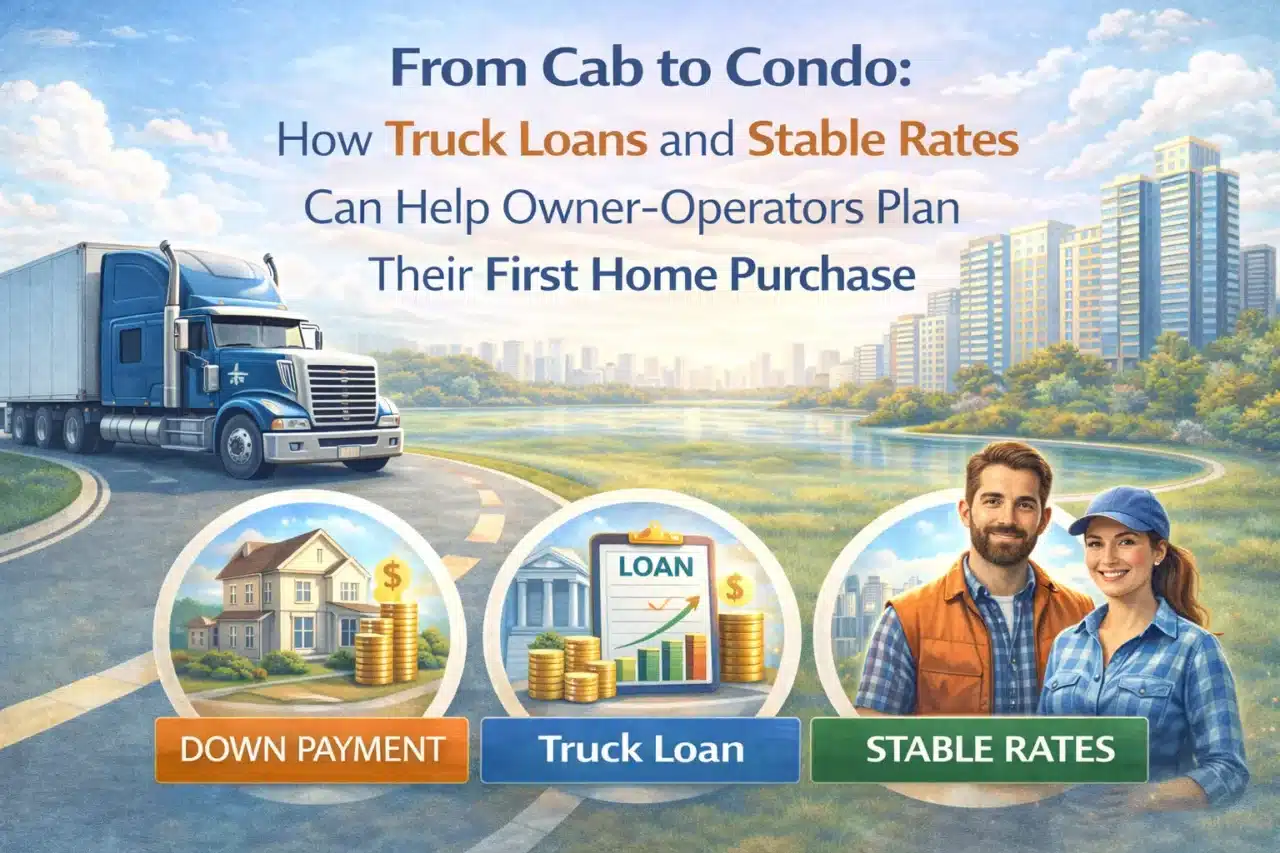
For thousands of truck owner-operators across Surrey, Abbotsford, the Fraser Valley, and Edmonton, the road to financial independence often begins behind the wheel.
You finance your first rig.
You build contracts.
You grow steady revenue.
But when it comes time to buy your first home, many owner-operators hit a wall.
Not because they lack income.
But because the way truck loans, write-offs, and self-employed earnings are structured often works against traditional mortgage approval.
Now, with interest rates stabilizing, 2026 presents a rare opportunity for owner-operators to synchronize truck financing and first-time home purchase planning properly—instead of letting one block the other.
This guide explains how truck loans affect mortgage approval, how self-employed income is assessed, and how owner-operators are successfully moving from cab to condo without sacrificing business growth.
Why do truck owner-operators struggle with mortgage approvals?
Unlike salaried employees, owner-operators face three structural lending challenges:
- Variable income
- Aggressive tax deductions
- Large commercial vehicle debt
Banks underwrite mortgages based on:
- Net declared personal income
- Two-year tax-filed averages
- Fixed monthly debt obligations
- Conservative self-employed risk models
Meanwhile, most owner-operators:
- Write off fuel
- Write off depreciation
- Write off maintenance
- Write off insurance
- Write off lease or loan payments
This minimizes taxable income—which is good for taxes—but can devastate mortgage qualification on paper.
Why 2026 creates a window for owner-operators?
The current environment is uniquely favorable because:
- Mortgage rates have stabilized
- Truck resale values remain strong
- Freight demand remains structurally supported
- Housing supply remains limited
- First-time buyer programs remain active
This allows owner-operators to:
- Plan financing 6–18 months ahead
- Optimize truck loan structure before mortgage application
- Re-balance debt-to-income ratios
- Build verifiable income profiles without business disruption
Instead of choosing between a truck or a home, smart operators are now structuring both together.
How does a truck loan impact mortgage qualification?
Truck loans are treated as commercial installment debt, but they affect your personal mortgage in three critical ways:
- Monthly obligation increases your Total Debt Service (TDS)
- High balances reduce borrowing capacity
- New truck loans create hard credit inquiries and risk flags
A $2,200/month truck payment can easily:
- Reduce your mortgage borrowing power by $300,000–$400,000
- Trigger bank declines even with strong revenue
- Force qualification through alternative or private programs
This is why loan timing matters more than loan size.
Should you buy the truck before or after the house?
This is one of the most expensive mistakes owner-operators make.
Buying the truck first:
- Increases current debt
- Suppresses mortgage approval
- Forces higher down payment requirements
- Triggers alternative lending
Buying the home first:
- Locks personal housing stability
- Preserves qualification
- Locks long-term fixed debt
- Allows business leverage later
In most cases, the correct sequencing is:
How do lenders calculate owner-operator income?
Most banks calculate self-employed income using:
- Two years of tax returns
- Add-backs for verified non-cash expenses
- Year-over-year income stability
They do not use:
- Gross revenue
- Bank deposits alone
- Contracts unless supported by tax filings
- Cash-flow statements without tax alignment
Alternative lenders, however, may use:
- 12–24 months of bank statements
- Gross business inflows
- Freight contracts
- Dispatcher revenue history
This is why lender selection is critical for truck operators.
Why Surrey has the highest truck-to-home demand in BC?
Surrey remains one of Western Canada’s strongest logistics hubs due to:
- Proximity to ports
- Warehousing and distribution clusters
- Cross-border freight operations
- High density of independent owner-operators
Many Surrey operators:
- Rent for years despite strong earnings
- Are blocked by truck loan structures
- Carry excellent business cash flow but weak tax income
With stable rates and proper financing alignment, this backlog of renters is now transitioning into ownership.
Why Abbotsford and the Fraser Valley favor owner-operator buyers?
Abbotsford and surrounding cities offer:
- Lower entry price than Metro Vancouver
- More townhome and detached inventory
- Secondary suite income opportunities
- Multi-generational buying potential
Truck operators here often:
- Live near dispatch routes
- Store equipment at home
- Combine rental suite income with business income
- Qualify using blended family income strategies
This makes Abbotsford one of the highest conversion markets for self-employed trucking professionals.
How does Edmonton fit into truck ownership + first home buying?
Edmonton remains:
- A freight and energy logistics anchor
- A cash-flow-positive real estate market
- A lower-down-payment ownership gateway for truck operators
Many BC-based operators:
- Invest in Edmonton rentals first
- Stabilize income through rental cash flow
- Build equity
- Later transition into BC ownership
Edmonton acts as a capital-building launchpad for many owner-operators.
How should truck loans be restructured before mortgage application?
Common pre-mortgage truck loan optimizations include:
- Extending term to lower monthly payment
- Consolidating multiple vehicle loans
- Re-classifying some business debt into corporate structure
- Paying down high-interest or short-term notes
- Avoiding new equipment purchases within 6–12 months of mortgage application
Lowering the monthly obligation matters more than lowering the balance.
Can owner-operators qualify as first-time buyers with only 5% down?
Yes—if:
- Credit profile is strong
- Property qualifies under insured guidelines
- Income documentation meets lender models
- Truck debt is structured correctly
However, many owner-operators achieve better approvals with:
- 10%–15% down
- Family-gifted down payments
- Equity recycled from co-borrowers
- Staged purchase planning
Should owner-operators incorporate before buying a home?
Incorporation helps:
- Tax efficiency
- Business scalability
- Asset segregation
- Equipment financing power
However, incorporating too early can delay personal mortgage eligibility if T4 salary history has not yet stabilized.
The ideal sequence is often:
- Stabilize personal home
- Then incorporate and scale operations
Can rental income help truck operators qualify?
Yes—very effectively.
Many owner-operators now:
- Buy homes with secondary suites
- Offset truck loan impact with rental income
- Strengthen debt-service ratios
- Create cash-flow buffers during slow freight cycles
This is one of the most powerful approval strategies in 2026.
What mistakes block owner-operators from buying homes?
The most common errors include:
- Buying new trucks within 90 days of mortgage application
- Running all income through corporate write-offs without planning
- Applying directly at banks without alternative lender screening
- Ignoring rental income strategies
- Using personal credit for business expansion
- Not modeling total debt-service ratios in advance
These mistakes delay ownership by years, not months.
What does a proper “cab-to-condo” financing strategy include?
A complete strategy integrates:
- Truck loan monthly obligation planning
- Two-year income modeling
- Credit optimization
- Rental income leverage
- Down payment sourcing
- Business-to-personal debt separation
- Exit planning into prime lending
This is not about getting approved once—it is about sustainable ownership without sacrificing business growth.
Expanded FAQs — Truck Loans & First-Time Home Buying (2026)
Can I qualify for a mortgage with an active truck loan?
Yes, if income and debt ratios are structured properly in advance.
Do banks consider my gross revenue?
No—banks focus on net taxable income. Alternative lenders assess cash flow differently.
Will a recent truck purchase hurt my mortgage approval?
Yes—new loans within 90–180 days can significantly reduce approval odds.
Should I pay off my truck before buying a home?
Not always. Lowering the monthly payment often matters more than eliminating the balance.
Can my spouse’s income help offset truck debt?
Yes—dual-income strategies often unlock approvals.
Is rental income from a basement suite accepted?
Yes—legal and documented rental income significantly strengthens approval.
Can owner-operators use private mortgages for their first home?
Yes—in transitional scenarios with large down payments and refinance planning.
Final Perspective: Your Truck Should Build Your Home—Not Block It
For owner-operators, your truck is not just a vehicle—it is a financial engine. But if that engine is not structured correctly, it can block your largest personal milestone: homeownership.
With stable rates in 2026, the right sequence of financing allows you to:
- Own your truck
- Grow your business
- And buy your first home
- Without sacrificing one for the other
Sandhu & Sran Mortgages helps owner-operators across Surrey, Abbotsford, the Fraser Valley, and Alberta align truck financing and mortgage strategy into one integrated plan—from cab to condo.
The road to your first home does not begin at the bank.
It begins with proper financial sequencing behind the wheel.